
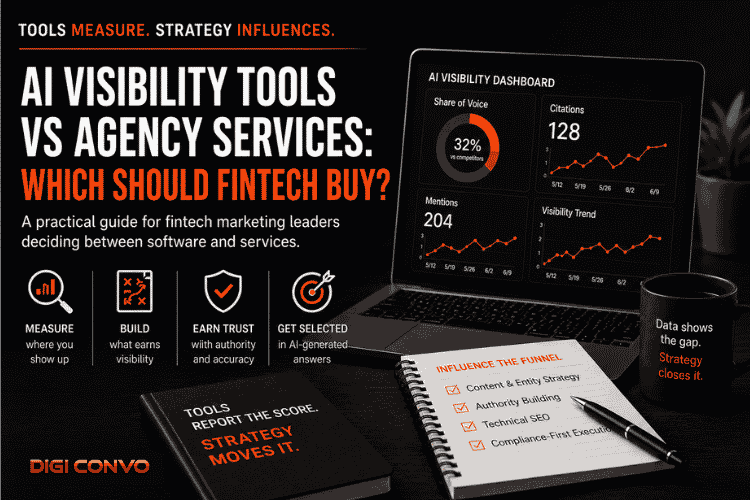
If your fintech is researching platforms like Profound, Scrunch AI, AthenaHQ, or Conductor, you are probably not just evaluating software. You are trying to answer a bigger question: should we monitor AI search ourselves, or bring in a partner to help us become the brand AI systems recommend?
Your CMO wants visibility into ChatGPT. Your SEO team wants a platform. Your leadership team wants results.
Those are not necessarily the same thing.
The wrong purchase is not just wasted software budget. It is spending six months measuring a visibility problem that nobody is actually fixing.
A dashboard can tell you that Stripe is being recommended instead of you. It cannot create the comparison pages, authority signals, and category positioning required to change that outcome.
That is the real decision behind this category. Not "Which tool should we buy?" But:
Do we have a measurement problem, or an execution problem?
A tool can tell you where you are invisible. It cannot decide what your fintech should become known for.
Key Takeaways
- --Determine whether you have a measurement problem or an execution problem before buying software.
- --Build content, authority, and positioning before investing in dedicated AI visibility tools.
- --Use AI visibility tools to monitor performance, not to create visibility.
- --Prioritize compliance-ready workflows when improving AI visibility in regulated fintech categories.
- --Add dedicated monitoring platforms only after visibility improvements begin generating measurable results.
At a Glance: What Tools Do vs What Services Do
| Question | AI visibility tool | Agency service |
|---|---|---|
| Shows where you appear in AI answers | Yes | Yes, via recurring engine sweeps |
| Tracks competitors and share of voice | Yes | Yes |
| Finds content gaps | Usually | Yes |
| Decides which gaps matter commercially | Limited | Yes |
| Writes and structures citation-ready pages | Sometimes, lightly | Yes |
| Handles fintech positioning | No | Yes |
| Handles compliance-sensitive messaging | No, or limited | Yes |
| Builds schema and internal linking architecture | Limited | Yes |
| Creates an executive-ready roadmap | Sometimes | Yes |
| Turns findings into pipeline assets | No | Yes |
Why This Decision Matters Now
- Adobe: AI-driven referral traffic to US sites grew more than tenfold between July 2024 and February 2025.
- Pew: 34% of US adults have now used ChatGPT, roughly double the 2023 share.
- Conductor: Visibility increasingly happens inside AI-generated answers where no click occurs. Mentions, citations, and inclusion in AI-generated shortlists can shape buying decisions before anyone reaches a website.
The question is no longer whether AI influences discovery. The question is whether your fintech is one of the brands being surfaced.
What AI Visibility Tools Actually Do
AI visibility tools track prompt visibility, citations, mentions, competitor share of voice, hallucinations, and overall visibility trends. Together, these metrics show where your fintech appears, how often it is cited, and which competitors are being recommended instead.
That is a real and useful body of work. But none of these capabilities creates authority, publishes content, restructures pages, or changes how your company is positioned.
The 2026 Tool Landscape
The category has sorted into a few recognizable tiers. The table does the rest.
| Platform | Best For | Typical Buyer | Watch-Out |
|---|---|---|---|
 | Enterprise AI visibility analytics | Large brands with internal teams | Requires operators |
 acq. by Sitecore, June 2026 acq. by Sitecore, June 2026 | AI search optimization programs | Enterprise marketing teams | Now a Sitecore product; standalone roadmap may shift |
 | Cross-platform monitoring | AI share-of-voice teams | Execution still required |
 | Existing enterprise SEO programs | Enterprise marketing organizations | Broader suite than AI-only |
  | Lightweight monitoring | Smaller teams testing the category | Limited strategic guidance |
Notice the watch-out column: every tier, from enterprise platform to lightweight monitor, assumes someone on your side will act on the data.
Do Traditional SEO Tools Track AI Visibility?
Do you need a dedicated AI visibility tool? Not always.
If you already pay for Ahrefs or Semrush, start there before buying another platform. Both already provide useful early signals around brand authority, content performance, and emerging AI visibility metrics. Dedicated platforms earn their keep when you need prompt-level tracking, citation monitoring, competitor AI share of voice, hallucination detection, and executive reporting.
The difference in coverage is the deciding factor. Ahrefs and Semrush have both introduced AI visibility features, but those capabilities still sit inside platforms originally built around rankings, backlinks, and keyword data. They catch part of the picture, but not all of it.
| Capability | Ahrefs | Semrush | Dedicated AI visibility platform |
|---|---|---|---|
| Rankings | Yes | Yes | Partial |
| Mentions in ChatGPT | Partial | Partial | Yes |
| Prompt tracking | No | Partial | Yes |
| Citation tracking | Partial | Yes | Yes |
| Competitor AI share | No | Partial | Yes |
| Hallucination monitoring | No | No | Yes |
The practical read for a fintech team: pull a free baseline from the tool you already have before you buy anything. Just know the baseline is partial. None of these -- bolt-on or dedicated -- tells you what to publish so the numbers move.
Where Tools Genuinely Earn Their Keep
A fair read of the category starts with what tools do well. The best platforms provide value in four areas that are difficult to replicate manually.
Baseline Visibility Audits
Before you change anything, a tool shows exactly where your fintech appears and where it does not. You can see which buyer questions trigger your brand, which competitors are being recommended instead, and where the biggest visibility gaps exist.
Competitive Benchmarking
Visibility only matters in context. A tool can show whether engines consistently recommend Stripe, Adyen, or another competitor in prompts where your company never appears. That turns AI visibility from a guessing game into a measurable competitive benchmark.
Continuous Monitoring
AI-generated answers change constantly. Daily engine sweeps catch citation gains, visibility drops, and brand inaccuracies as they happen, not months later. That is difficult for an internal team to maintain by hand.
Executive Reporting
Most leadership teams do not want prompt-level data. They want to know whether visibility is improving, declining, or staying flat. Share-of-voice metrics and trend reporting turn AI search into a KPI executives can track over time.
This is genuine value, and it is why the stronger fintech programs run a tool. The question is never whether the data is useful. It is whether the data, on its own, moves the number it measures.
Where Tools Fall Short for Fintech
Every AI visibility platform eventually reaches the same limit. A tool can tell you where you are invisible. It cannot decide what your fintech should become known for.
Tools Identify Gaps. They Do Not Close Them.
A platform can report that a competitor owns the "best cross-border B2B payment API" prompt. It cannot decide which buyer questions your company should own, write the comparison page that wins the prompt, or build the third-party authority that makes an engine trust the claim. The software finds the gap. It does not fill it.
Tools Measure the Visibility Funnel. They Do Not Influence It.
The cleanest way to see the distinction is the Visibility Funnel. AI engines select sources in four stages: Retrieved, Filtered, Trusted, and Selected. Tools measure all four stages. They influence none of them.
Agencies work the other side of the same funnel, building the content that gets retrieved, the structure that survives filtering, the authority that earns trust, and the comparison and definition pages that win selection. Measurement and influence are different jobs. Many fintech teams discover they have purchased the first while still needing the second.
The Compliance Problem With Automated AI Content
Most industries can publish the moment they identify an opportunity. Fintech cannot.
Say a tool flags a high-value opportunity around "best business checking account for startups." Someone still has to clear the resulting content against internal review standards, regulatory guidance, and approved marketing claims before it can publish. Lending claims, investment claims, and banking product claims all require legal and compliance review. Several AI visibility platforms now bundle content-generation features that can draft those claims before any review has occurred.
The risk is not that the draft is unusable. The risk is that it appears finished when it still requires review. A tool can identify the opportunity. It does not own the regulatory risk that comes with acting on it. In fintech, visibility work requires human-in-the-loop control over regulated claims. That is a workflow challenge, not a software feature.
The Total Cost of Data
The sticker price of a platform is rarely the real cost. The data only converts to outcomes if someone interprets it and acts, and that someone is an operator the tool does not include.
| Cost component | Typical monthly cost |
|---|---|
| AI visibility platform | $2,000 to $5,000+ |
| Internal operator | $6,000 to $10,000+ |
| Content production | Additional |
| Technical implementation | Additional |
Many fintech teams discover they have purchased measurement before building execution capacity.
When a Fintech Should Buy a Tool
Buy a tool when you already have the system it measures. The good-fit profile is specific:
- --An in-house SEO team that can read prompt-level data and act on it
- --An in-house content team publishing on a consistent cadence
- --A technically healthy site that can absorb schema and structural changes
- --The analytical capacity to turn a share-of-voice chart into a decision
- --Reporting needs that span many products, regions, or competitors
A fintech that checks those boxes already has the execution engine running. For that team, Profound, AthenaHQ, or Scrunch AI is reasonable instrumentation on top of work already underway, and the daily cadence justifies the cost. The tool measures an existing machine. If the machine does not exist yet, the reporting arrives before the capability.
When a Fintech Should Hire an Agency
Most fintech marketing teams are not deciding between Profound and AthenaHQ. They are deciding whether they have the internal capacity to act on what those platforms report. Hire a service if any of these is true:
- --You do not know which buyer questions matter most.
- --You do not have comparison pages.
- --You do not have entity authority around your category.
- --Publishing is inconsistent.
- --Compliance review slows content production.
- --Marketing owns growth but lacks specialized GEO expertise.
These are not measurement problems. They are execution problems that sit on the influence side of the funnel. A tool can tell you that a competitor owns an important buyer question. It cannot create the comparison page, authority signals, and supporting content required to win that question. That gap is the AEO versus GEO distinction in practice: a tool reports on extraction, whereas selection must be built.
The service category itself has different jobs inside it; our guide to AEO, GEO, and SEO agencies helps separate the partner needed to diagnose the gap from the one needed to execute against it.
The proof that building moves the number: an embedded finance fintech at Domain Rating 41, ranked #1 for "unified payments platform" above Stripe at Domain Rating 93, and grew AI-referred sessions from 17 to 477 in a single quarter. Dashboards measured that result. They did not produce it.
For how the service-side options compare, see the best AI visibility agencies for fintech.
The Best Model for Most Fintechs: Strategy, Then Software
For most fintech organizations, the winning approach is agency-led strategy with tool-supported measurement.
Not tool versus agency. The two in sequence.
First decide what your company should be known for. Then build the content, authority, and technical architecture required to earn that position. Only then does it make sense to measure it.
That sequencing reflects how AI visibility actually works.
Brands must be retrieved, filtered, trusted, and selected before they can appear in an answer. Tools help measure those stages. Strategy, content, authority, and technical execution influence them.
Buy the measurement before the influence exists, and you spend six months watching a number that has no reason to move.
For many fintech teams, a recurring sweep across ChatGPT, Gemini, Claude, and Perplexity provides enough measurement during the build phase. Dedicated platforms become more valuable once there are citations, rankings, and competitive visibility trends worth monitoring every day.
You add the dashboard once there is something on it worth watching.
A tool can tell you where you are invisible. It cannot decide what your fintech should become known for.
FAQs
Should fintech companies buy AI visibility tools or hire an agency first?
Most fintech companies should build strategy before buying software. If you are not consistently appearing in AI-generated answers, the bigger opportunity is usually content, authority, and positioning, not measurement.
What do AI visibility tools actually measure?
AI visibility tools track where your brand appears across platforms like ChatGPT, Gemini, Claude, and Perplexity. Most platforms monitor citations, mentions, competitor share of voice, prompt visibility, and visibility trends over time.
When is an AI visibility tool worth the cost?
An AI visibility tool is worth the investment when you already have a team capable of acting on the data. Companies with established content programs, technical resources, and ongoing optimization efforts typically benefit more from dedicated monitoring platforms than organizations still building foundational visibility.