
Most fintech marketing teams evaluating AEO agencies, GEO agencies, and AI SEO agencies are trying to solve the same underlying problem: why doesn't our company show up when a buyer asks AI about our category?
The acronyms only matter because they help identify the problem. The real question is not which acronym is newest. It is the visibility problem you actually have.
This is not a story about SEO being dead and AI optimization taking over. It is a story about three layers of the same job, and knowing which layer is broken.
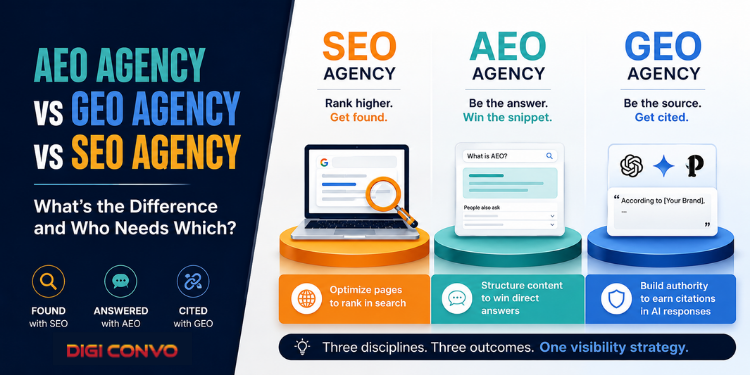
SEO gets you found. AEO gets you answered. GEO gets you cited.
Key Takeaways
- --Diagnose the visibility gap before hiring an agency to avoid solving the wrong search problem.
- --Build SEO foundations first to enable AI citations and recommendations.
- --Evaluate AI SEO agencies carefully to separate production efficiency from AI visibility expertise.
- --Prioritize GEO when competitors appear in ChatGPT while your brand remains absent.
- --Align marketing, compliance, and leadership early to accelerate fintech AI visibility initiatives.
SEO, AEO, and GEO agencies at a glance
| Agency type | Primary goal | Main focus | Typical outputs | Best fit |
|---|---|---|---|---|
| SEO agency | Rank pages and earn organic clicks | Keywords, technical SEO, site structure, backlinks, content | Higher rankings, more sessions, more leads | Brands that need more qualified organic traffic |
| AEO agency | Be selected as the direct answer | Structured Q&A, schema, concise definitions, FAQ formatting | Featured snippets, People Also Ask, AI Overview citations, answer boxes | Brands targeting zero-click and answer surfaces |
| GEO agency | Be cited and recommended by AI | Entity authority, comparison content, third-party citations, prompt visibility tracking | Brand mentions and citations inside AI-generated answers | Brands that need to appear in AI-assisted vendor research |
The short version: an SEO agency optimizes pages, an AEO agency optimizes answers, and a GEO agency optimizes how AI systems understand and cite your brand.
Three layers, not three competitors
| Layer | Goal |
|---|---|
| SEO | Make your content discoverable |
| AEO | Make your content extractable |
| GEO | Make your brand citable |
Think of them as layers rather than competitors. SEO helps search engines find your content. AEO helps answer engines extract your content. GEO helps AI systems trust, cite, and recommend your brand.
What each agency actually does
What an SEO agency does
An SEO agency optimizes your site to rank in traditional search results. It works on the foundation layer: keyword research, technical SEO, crawlability, site structure, backlinks, and content. The goal is higher rankings, more qualified traffic, and more leads. Every other layer depends on this one being healthy. If a page cannot be crawled and indexed, nothing downstream can use it. SEO is the foundation. AEO and GEO are built on top of it.
What an AEO agency does
An AEO (answer engine optimization) agency structures your content to be selected as the direct answer. It formats information into clean questions and answers, adds FAQ and structured data schema, writes concise definitions, and targets answer surfaces such as featured snippets, People Also Ask results, AI Overviews, and conversational AI interfaces.
The goal is simple to state: be the answer.
What a GEO agency does
A GEO (generative engine optimization) agency builds the authority and visibility signals that make AI systems cite and recommend your brand inside generated responses. The work centers on entity authority, third-party citations, comparison content, and source architecture. Many GEO agencies also track visibility and citation patterns across ChatGPT, Gemini, Claude, and Perplexity.
The goal is not simply to rank or answer a question. It is to become a source AI systems trust enough to reference. AEO is about being the answer. GEO is about being a cited source inside the answer.
Another way to think about it: each agency optimizes a different unit of the web -- pages, answers, and entities.
| Focus | SEO agency | AEO agency | GEO agency |
|---|---|---|---|
| Primary unit of value | Web page / URL | Answer snippet | Brand entity |
| Core targets | Google rankings, local pack | Featured snippets, People Also Ask, AI Overviews | ChatGPT, Perplexity, Gemini, AI Overviews |
| Optimization mechanics | Keywords, site architecture, page speed, backlinks | Q&A formatting, FAQ schema, structured data | Entity mapping, citations, authority signals |
| Primary metric | Clicks, rankings, organic traffic | Snippet share, position zero visibility | Citation share, AI share of voice, brand mentions |
| Content style | Comprehensive, long-form | Direct, declarative | Authoritative, data-backed, comparison-led |
The "AI SEO agency" trap
There is a fourth term in this conversation, and it is the most confusing one: AI SEO agency. It is also the most searched, which makes the confusion expensive.
The problem is that "AI SEO agency" can mean two completely different things depending on who uses it.
Type 1: An SEO agency that uses AI internally
These agencies use AI tools to produce traditional SEO deliverables faster. They may generate content briefs, draft articles, perform audits, analyze keywords, or automate reporting. The output is still traditional SEO. The AI is a production tool.
Type 2: An agency that optimizes for AI search
These agencies focus on helping brands appear inside ChatGPT, Google's AI Overviews, Gemini, Perplexity, Claude, and other AI-assisted discovery systems. The output is AI visibility. The AI is the destination.
Those are not variations of the same service. One makes SEO more efficient to produce. The other changes where your brand shows up.
Ask before you sign
When you say AI SEO, do you mean AI-assisted production or AI-search visibility strategy? The answer tells you which agency you are actually talking to.
Where they overlap: you can't skip the foundation
It is tempting to treat AEO and GEO as replacements for SEO. They are not. They are layers built on the same foundation, and the foundation is still traditional search.
Generative answers are not conjured from nowhere. When an AI engine answers a question, it retrieves real pages and summarizes them -- a process known as retrieval-augmented generation. Google is explicit about this: its generative AI features are rooted in its existing Search ranking and quality systems. A page must be indexed and eligible to appear in Search before it can appear in an AI Overview at all.
If your technical SEO is broken, the generative engine never sees your content to cite it. Crawlability and indexing are not legacy concerns. They are the entry ticket to the AI answer.
At the same time, appearing in an AI-generated answer is not exactly the same problem as ranking a page. That is why GEO emerged as its own discipline. The original GEO research, published at KDD 2024, demonstrated that deliberate changes to content structure and presentation could improve visibility within generative responses by up to 40%.
| Layer | What it does |
|---|---|
| SEO | Builds the architecture and earns the crawl |
| AEO | Structures the content so it can be extracted |
| GEO | Builds the authority that makes an engine trust and cite the brand |
Skip the foundation, and the layers above it have nothing to stand on.
Which one do you need?
The fastest way to choose is to start with the symptom, not the service.
| The problem you have | The agency you need |
|---|---|
| We don't rank in Google. | SEO agency |
| We rank, but AI answers ignore us. | GEO agency |
| Our content isn't used in direct answers or snippets. | AEO agency |
| We need visibility across Google and AI engines. | GEO / AI visibility agency |
| We're fintech, and compliance slows everything down. | A governed AI visibility partner (see below) |
Most companies do not fit neatly into a single row, and that is fine. Some teams start by evaluating software before hiring an agency. If you are weighing that decision, see our comparison of AI visibility tools vs agency services.
Once you have identified the agency type you need, use the fintech buyer's evaluation checklist to run a structured comparison across candidates before committing.
Visibility problems often occur at different stages of the AI buying journey. See the AI Visibility Funnel for a deeper breakdown of where those gaps typically occur.
The outcome can be concrete: our embedded finance platform case study shows how a focused category and comparison strategy helped a smaller provider compete for a high-value buyer query.
Why fintech needs a more careful version
Everything above applies to any company. Fintech adds a constraint most industries do not carry: you cannot publish first and clean it up later.
When a generic brand spots a content opportunity, it ships the page. When a fintech spots the same opportunity, the page often moves through compliance, legal, risk, and brand review before it ever goes live. Claims about rates, fees, eligibility, returns, security, or regulatory standing have to be accurate and approved. That is not optional, and it is rarely fast.
In many industries, visibility is primarily a marketing problem. In fintech, it is a cross-functional problem. Marketing owns the visibility goal. Compliance owns the claims. Risk owns the governance. Leadership owns the budget and expected return.
An AEO or GEO program that ignores those realities usually stalls the moment review begins, no matter how strong the keyword research or content strategy may be.
Fintech does not need a different framework. It still needs SEO, AEO, and GEO. It simply needs those disciplines executed with compliance, governance, and trust built into the process from the beginning.
Where DIGI CONVO fits
DIGI CONVO is best described as a GEO-led AI visibility agency for fintech.
We use SEO to build the foundation, AEO to improve answer extraction, and GEO to improve how AI systems understand, compare, cite, and recommend brands. If you are evaluating providers, our review of the best AI visibility agencies for fintech breaks down how different firms approach SEO, AEO, GEO, and AI visibility.
SEO gets you found. AEO gets you answered. GEO gets you cited.
That distinction matters because most fintech companies do not have a ranking problem alone. They have a visibility problem that spans traditional search, AI-generated answers, and vendor research workflows.
FAQs
Is a GEO agency better than an SEO agency?
A GEO agency is not better than an SEO agency; it solves a different problem. SEO focuses on rankings and organic traffic, while GEO focuses on helping AI systems cite and recommend your brand. Most companies need strong SEO first, then GEO to improve AI visibility.
How do I know if I need a GEO agency?
You likely need a GEO agency if your company ranks in Google but rarely appears in ChatGPT, Gemini, Perplexity, or AI-generated answers. Review whether competitors are being cited more often than your brand. Visibility gaps in AI search are often a GEO problem rather than an SEO problem.
Can an AEO agency improve visibility in AI Overviews?
Yes, an AEO agency can improve your chances of appearing in AI Overviews by structuring content for extraction. Common tactics include FAQ schema, concise definitions, and question-and-answer formatting. The goal is to make your content easier for search and AI systems to use as a source of answers.
What should I ask before hiring an AI SEO agency?
Ask whether the agency focuses on AI-assisted SEO production or an AI-search visibility strategy. Many agencies use AI to create content faster, but do not optimize for ChatGPT, Gemini, or AI Overviews. Clarifying this distinction helps ensure you buy the service you actually need.
Can SEO, AEO, and GEO work together?
Yes, SEO, AEO, and GEO are complementary disciplines. SEO makes content discoverable, AEO makes it easier to extract as an answer, and GEO helps AI systems trust and cite your brand. Companies that combine all three typically have stronger visibility across both traditional search and AI-driven discovery.