
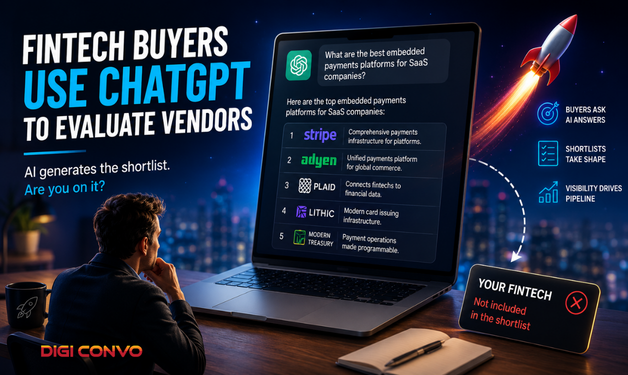
Fintech buyers increasingly use ChatGPT, Gemini, Claude, and Perplexity to build their initial vendor shortlist before visiting company websites. If your company is missing from those answers, you may be eliminated before a buyer ever reaches your website or contacts your sales team.
According to Forrester's 2026 study of roughly 18,000 business buyers, generative AI became the single most influential research source, cited twice as often as vendor websites, peer referrals, or sales representatives. The first stage of vendor evaluation is shifting from search engines to AI-generated recommendations.
AI is becoming the first vendor shortlist in fintech.
This article explains why established companies like Stripe, Adyen, and Plaid are frequently recommended, how smaller fintechs are breaking into those spaces, and what marketing teams should measure to earn a place on the shortlist.
Key Takeaways
- --Test your top five buyer queries across ChatGPT, Gemini, Claude, and Perplexity to see whether your fintech makes the shortlist.
- --Measure AI citation rate alongside search rankings to uncover visibility gaps before they become pipeline problems.
- --Strengthen entity signals with clear category positioning and third-party validation to increase AI recommendations.
- --Prioritize content that answers vendor-selection questions rather than chasing high-volume keywords.
- --Treat AI-generated shortlists as the new top-of-funnel and optimize for inclusion before buyers visit your website.
The first shortlist is now an AI answer
The discovery step that used to be a Google search and three open tabs is now a single question to an answer engine that returns a complete list. Buyers still evaluate vendors the same way. They have simply changed the first step.
Increasingly, the first step in evaluating fintech vendors is not a search engine but an AI assistant. Buyers ask ChatGPT, Gemini, Claude, or Perplexity to discover, compare, and narrow a list of vendors before they visit a company website or speak with a sales team.
Among B2B buyers, the behavior is already mainstream: in 6sense's 2025 Buyer Experience Report, 94% said they use generative AI at some point in the buying process, and G2's 2026 research found that half now begin vendor research with an AI chatbot rather than a search engine.
Buyers also rarely stop at one engine. They run the same question through ChatGPT, Gemini, Claude, and Perplexity and treat disagreements among the answers as a signal worth investigating. A vendor named in one engine and missing from the others looks weaker by comparison, even when the product is stronger.
What fintech buyers actually type
The prompts are practical and specific. They are vendor-selection questions a marketing or operations leader would once have asked a colleague:
- --"Best embedded payments platforms for SaaS companies"
- --"Stripe Connect alternatives for marketplaces"
- --"Which payouts provider is best for paying global contractors"
- --"Compare Adyen and Stripe for a platform business"
- --"What card-issuing platform do fintechs use instead of building in-house"
Each prompt returns a named list. That list is the shortlist in miniature: the set of companies the buyer will actually consider. If your fintech is not in the answer, you are not in the consideration set, and you usually never learn the conversation happened.
Why the engine names Stripe and not you
When a buyer asks an AI engine for payment infrastructure, Stripe, Adyen, and Plaid are frequently among the first companies the engine names, not because they fit the buyer's use case, but because they are the most reinforced entities in the category.
This is the DIGI CONVO Visibility Funnel.
DIGI CONVO's Visibility Funnel
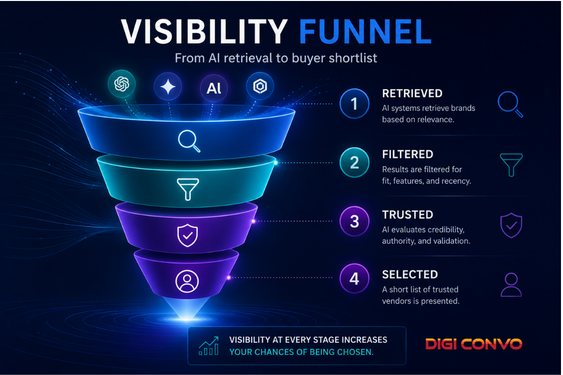
AI engines move through those four stages as they assemble an answer, and most fintechs fall out at the filter stage.
Retrieval is the first gate. If the engine cannot clearly identify your category and use case, you never enter the candidate set. Filtering drops content that is vague or hard to extract. Trust favors companies whose claims are reinforced beyond their own website. Selection is the final cut.
Stripe, Adyen, Plaid, and newer infrastructure names like Lithic and Modern Treasury clear those gates because they are described, explained, and validated across the web, so the engine treats them as safe to repeat.
Fintech raises the bar even higher: because financial content is held to a stricter standard of trust, engines lean even harder on reinforced entities and third-party validation before naming a company. The result is structural. A company can have the better product and still never reach the shortlist if the engine cannot retrieve and trust its content.
You can see the full mechanism, stage by stage, in the Visibility Funnel.
Smaller fintechs are already winning
Smaller fintechs are already winning these answers. One embedded finance platform outranked a category incumbent for the query "unified payments platform" while dramatically increasing AI-referred traffic in a single quarter.
The numbers behind that result are compelling. The company grew AI-referred sessions from 17 to 477 in one quarter while total organic traffic increased from 74,588 to 94,536.
PayQuicker, in global payouts, grew AI-referred traffic from 15 to 257 and expanded its ranking footprint to roughly 1,500 terms over 18 months.
Neither company outspent the incumbents. They built the content structures that engines assemble answers from, so their content was retrieved, trusted, and selected for the queries their buyers were actually typing. The pattern repeats across the category, which is the subject of the Embedded Finance AI Citation Study.
What this means for fintech marketing leaders
If AI builds the first shortlist, your fintech's citation rate in AI-generated answers becomes a pipeline metric, not a curiosity. The question is no longer "Where do we rank?" It's "Do we get invited into the buying conversation at all?"
Most marketing teams have never checked. Fortunately, it takes about 10 minutes.
The DIGI CONVO Five-Query Test
5-QUERY TEST — ~10 minutes
- 1Run your five most important category questions.
- 2Test them in ChatGPT, Gemini, Claude, and Perplexity.
- 3Record who appears.
- 4Record who gets cited.
- 5Repeat monthly.
If you weren't your own company, would you shortlist yourself?
Read the answers the way a buyer would. Notice who gets recommended, who gets ignored, and which competitor consistently earns the position you want.
The companies winning AI search are not necessarily the ones with the biggest budgets or the strongest domain authority. They are the companies AI can retrieve, filter, trust, and ultimately select when a buyer asks who to consider.
The shift has already happened. Buyers are asking AI to build the first shortlist. The only remaining question is whether your fintech is on it.
When you are ready to hire an agency to close that gap, evaluate an AI visibility agency with a procurement-grade checklist before the first proposal lands.
See where AI search is leaving you out. The AI Visibility Diagnostic shows exactly where competitors are cited, and your company is missing across ChatGPT, Gemini, Claude, and Perplexity before the first sales conversation.
FAQs
How do fintech buyers use ChatGPT to evaluate vendors?
Fintech buyers use ChatGPT to identify, compare, and narrow potential vendors before visiting company websites. They typically ask category, comparison, and use case questions, then validate the results across multiple AI assistants before engaging sales teams.
Why doesn't my fintech appear when buyers use ChatGPT to evaluate vendors?
Your fintech may be missing because AI cannot confidently retrieve, verify, or recommend your company. Strengthen category positioning, publish content that answers buyer questions, and reinforce credibility through third-party mentions and structured information.
How can I tell if ChatGPT recommends my fintech company?
Run your most important buyer questions through ChatGPT, Gemini, Claude, and Perplexity to see whether your company appears. Repeat the same queries regularly to track changes and consistently identify competitors that are earning recommendations.
Does ranking on Google help fintech buyers find us in ChatGPT?
Google rankings help, but they do not guarantee inclusion in AI-generated answers. AI assistants prioritize clear entity recognition, trusted sources, and content that directly answers vendor evaluation questions alongside traditional search signals.
What content should fintech marketing teams create for ChatGPT vendor evaluation?
Create content that answers the exact questions buyers ask while comparing vendors. Prioritize comparison pages, category definitions, use case guides, implementation content, and third-party validation over broad, keyword-focused blog posts.