
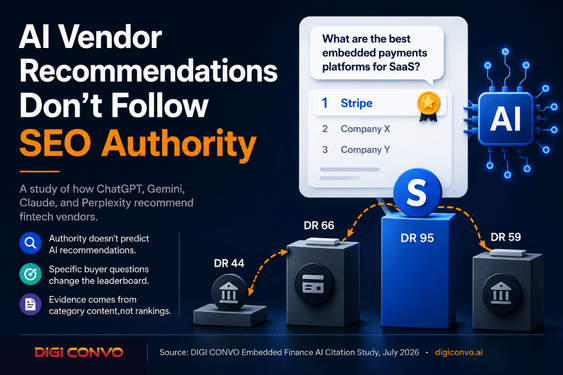
In a study of 40 AI-generated answers to embedded finance buyer questions, domain authority stopped predicting AI recommendations below a Domain Rating of roughly 80. Across the 13 companies under that threshold, the correlation between authority and AI recommendations was effectively zero (Spearman −0.03).
The starkest pair: Rapyd, with a Domain Rating of 74 and roughly 6,000 referring domains, was named once in 40 answers. Treasury Prime, with a Domain Rating of 49 and a quarter of the authority, was named 19 times.
We asked ChatGPT, Gemini, Claude, and Perplexity the same ten questions a real embedded finance buyer might ask, recorded every company each engine recommended, and compared those recommendations with each company's search authority.
Fifteen companies. Four engines. One collection window in July 2026.
The result, in one sentence: AI recommendations in embedded finance are not distributed by authority. Below the giants, traditional authority no longer explains who gets recommended. The rest of this study is about what does.
Key Takeaways
- Authority stopped predicting visibility below DR 80. Across the 13 companies under that threshold, the correlation between Domain Rating and AI recommendations was zero.
- Several focused embedded finance providers consistently outperformed much larger competitors. Treasury Prime, Unit, and Synctera outperformed companies with far more authority, including Rapyd and Modern Treasury.
- The question determines the leaderboard. Stripe was named first in 15 of 16 generic category answers, but in only 1 of 12 specialist answers.
- The engines' evidence is mostly SEO content about the category. The most-cited sources were aggregator blogs and vendor comparison pages, not press or research.
- Two of the four engines showed no sources at all. Gemini and Claude named vendors in every answer without displaying a single source, and three of four engines produced identifiable entity errors.
What We Measured
We selected 15 embedded finance companies spanning a wide authority range, from Stripe (Domain Rating 95) to two companies at Domain Rating 44 at the lower end, so the study could test whether authority predicts visibility rather than assume it.
The companies were chosen because they consistently appear in analyst reports, industry comparisons, and embedded finance vendor lists. They represent the providers buyers are most likely to evaluate, not the entire market. The set covers embedded payments, banking-as-a-service, card issuing, and payment operations: Stripe, Adyen, Marqeta, Galileo, Modern Treasury, Unit, Treasury Prime, Synctera, Column, Increase, Lithic, Embedded Finance Platform A, Finix, Moov, and Rapyd.
We then asked ChatGPT, Gemini, Claude, and Perplexity ten questions phrased the way buyers actually ask them, from "best embedded payments platforms for SaaS companies" to "which banking-as-a-service providers are best for launching a fintech product." Every question ran in a fresh chat using the publicly available consumer version of each assistant, with default settings, US location, first response only, all within a single collection window on July 14, 2026. That produced 40 answers.
A company counted as recommended when an engine named it as an option in the answer, not when it appeared in passing. For every answer, we recorded which of the 15 companies were named and in what order, which company was named first, which companies outside our set appeared, and which source domains the engine showed.
Authority baselines (Domain Rating, organic traffic, referring domains) come from Ahrefs, pulled the same day. The full protocol, including every prompt and every limitation, is in the methodology section at the end.
Figure 1 shows the study's central finding.
Authority Stops Predicting Visibility Below DR 80
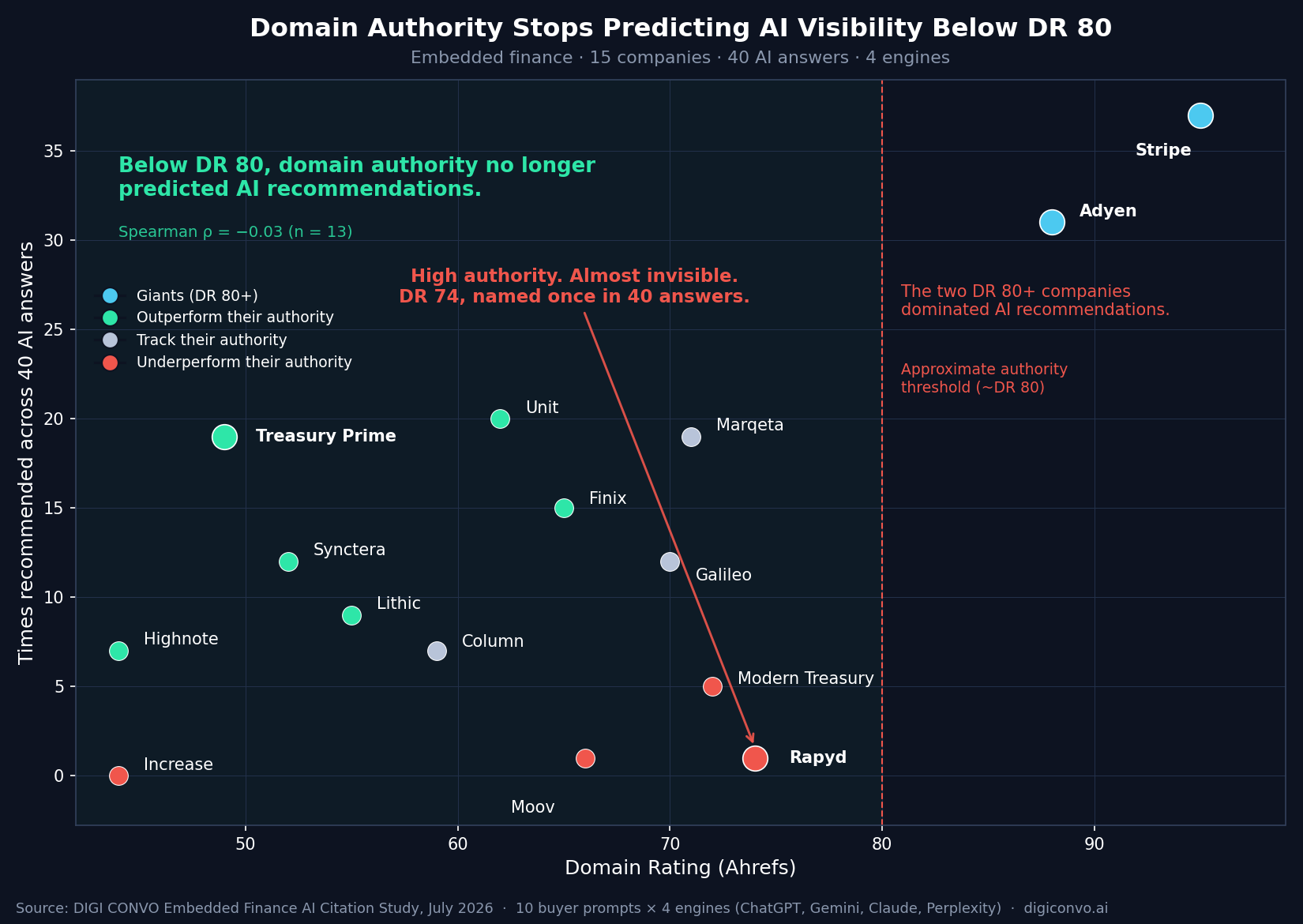
Across all 15 companies, the linear (Pearson) correlation between Domain Rating and AI recommendations was 0.61. That overall correlation hides the real pattern, and the scatter plot shows why: the entire relationship is carried by two companies.
Stripe (DR 95) was recommended in 37 of 40 answers and named first in 23 of them. Adyen (DR 88) was recommended in 31. The two DR 80+ companies dominated AI recommendations.
Remove them, and the relationship disappears. Across the 13 companies below DR 80, both the linear and rank correlations collapsed: Pearson 0.03, Spearman −0.03.
Referring domains did no better (Spearman 0.02). Within this sample, once a company falls below the giant tier, knowing its authority tells you almost nothing about how often AI recommends it.
The individual results make the disconnect concrete.
| Company | Domain Rating | Recommended (of 40) | Avg. position | Named first |
|---|---|---|---|---|
| Stripe | 95 | 37 | 1.6 | 23 |
| Adyen | 88 | 31 | 2.4 | 3 |
| Unit | 62 | 20 | 2.6 | 6 |
| Marqeta | 71 | 19 | 4.4 | 2 |
| Treasury Prime | 49 | 19 | 4.1 | 0 |
| Finix | 65 | 15 | 3.1 | 0 |
| Galileo | 70 | 12 | 4.5 | 0 |
| Synctera | 52 | 12 | 4.2 | 0 |
| Lithic | 55 | 9 | 5.2 | 2 |
| Column | 59 | 7 | 5.7 | 1 |
| Embedded Finance Platform A | 44 | 7 | 6.6 | 0 |
| Modern Treasury | 72 | 5 | 6.0 | 0 |
| Moov | 66 | 1 | 4.0 | 0 |
| Rapyd | 74 | 1 | 7.0 | 0 |
| Increase | 44 | 0 | n/a | 0 |
Read down the Domain Rating column and the pattern breaks everywhere you look. Treasury Prime, at DR 49, was recommended as often as Marqeta at DR 71. Synctera (DR 52) doubled Modern Treasury (DR 72).
Embedded Finance Platform A, tied for the lowest authority in the set at DR 44, was recommended seven times; Rapyd, with a Domain Rating thirty points higher and roughly 6,000 referring domains, was recommended once.
The companies that outperformed their authority also shared a noticeable characteristic. Treasury Prime and Synctera are closely associated with banking-as-a-service. Unit is closely associated with embedded banking. Lithic and Embedded Finance Platform A are closely associated with card issuing.
By contrast, the companies that underperformed generally span multiple products and markets. Rapyd positions across global payments, payouts, and wallets. Moov positions across money-movement workflows.
One possible explanation is that AI systems reward category clarity more than overall domain authority. This study did not directly measure category clarity, so that interpretation remains a hypothesis rather than a finding. The next two sections provide additional evidence consistent with that explanation.
One more observation belongs here. Increase, the only company recommended zero times, shares its DR 44 with Embedded Finance Platform A, which was recommended seven times. Same authority, opposite outcomes. Whatever separates them, it is not Domain Rating.
The Leaderboard Changes With the Question
The question itself reshapes the leaderboard. Companies that rarely appear in broad category answers became consistent recommendations when the buyer asked about a specific capability, and the dominant company in generic answers nearly vanished from the lead position in specialist ones.
Stripe is the clearest evidence. Across the 16 answers to our four generic prompts, covering embedded payments platforms, payment infrastructure for SaaS, embedded finance platforms for vertical SaaS, and the overall category landscape, Stripe was named first in 15. On specialist questions, that dominance disappeared.
Across the 12 answers to our three specialist prompts, covering card issuing, banking-as-a-service, and embedded business bank accounts, Stripe was named first only once. The lead positions went to companies whose names are tied to those specific jobs: Lithic and Marqeta split the card issuing answers, and Unit was named first in 6 of the 8 banking answers, with Column taking one of the remainder.
The opposite pattern appeared among the challengers. On the banking-as-a-service prompt, all four engines recommended both Treasury Prime and Synctera, the two overperformers from Figure 1.
Neither company was ever named first across the dataset, but both became consistent recommendations when the buyer's question matched their specialty. Being the first recommendation and being consistently included are different kinds of visibility, and the challengers in this dataset earned the second kind.
One prompt type produced a different behavior entirely. When we asked the engines how to choose an embedded payments provider, a decision-criteria question rather than a vendor-list question, brand recommendations nearly vanished.
Most engines named only two or three companies, almost always Stripe and Adyen, as illustrative examples inside an evaluation framework. In this sample, challengers effectively could not appear in criteria answers at all.
The interpretation we draw is modest: within this dataset, a challenger's opportunity to be recommended lived almost entirely in specific buyer questions, not in the broad category question, and not in criteria questions the incumbents anchor by default. Whether that holds across other verticals is a question for future collection windows.
What the Engines Cite as Evidence
The evidence behind AI vendor answers turned out to be three findings, not one: most engines hide their evidence entirely, the evidence that is visible is mostly category SEO content, and being cited as evidence is not the same as being recommended.
Most Engines Hide Their Evidence
| Engine | Avg. companies named per answer | Answers with sources shown |
|---|---|---|
| ChatGPT | 6.0 | 7 of 10 |
| Perplexity | 4.9 | 10 of 10 |
| Gemini | 4.7 | 0 of 10 |
| Claude | 3.9 | 0 of 10 |
Gemini and Claude displayed no sources in any of their 20 answers. Both recommended vendors in every answer, and Claude in particular stated precise figures, including market sizes and named companies' loan volumes, without showing where any of them came from. Whatever these engines relied on, a buyer reading the answer cannot inspect it, and a vendor cannot see what earned or lost a recommendation.
When Evidence Is Visible, It Is Mostly Category Content
Across Perplexity's 10 answers, we recorded 60 citations spanning 44 unique domains.
Among the sources we observed, the most frequently cited were not financial press or analyst research. They were SEO aggregator blogs and vendor content: fintechspecs.com and openbankingtracker.com (5 citations each), followed by connectpay.com and swipesum.com, both vendors in the categories being discussed.
Perplexity also cited a YouTube video, a dev.to post, LinkedIn, and PR-wire coverage. ChatGPT's source trail was similar in kind, mixing vendor sites, niche blogs, and Reddit threads, which it cited in 2 of its 10 answers.
Citation Does Not Guarantee Recommendation
The sharpest single example came from the decision-criteria prompt. Perplexity's answer, a framework for how to evaluate embedded payments providers, drew its citations primarily from finix.com, Finix's own content library. Finix was never named as a provider anywhere in the answer.
A vendor's content supplied the buyer's evaluation criteria without the vendor earning a recommendation. Finix influenced how the engine framed the buying decision without becoming one of the recommended vendors. Influence and recommendation turned out to be separate outcomes.
We did not measure why engines select these sources, and this study cannot say whether citing a domain causes future recommendations.
What the data does show is narrower and still consequential: in this sample, the visible evidence behind AI vendor answers was substantially the structured comparison content that companies and aggregators published about the category. That is a surface any company can see, audit, and build for.
The Answers Contain Errors Buyers Cannot See
Three of the four engines produced identifiable entity errors in their answers, and the two engines that never showed sources were among them.
The errors were small, specific, and the kind a buyer would have no way to catch. We observed four types:
- Gemini: referred to "Standard Connect," where Stripe Connect was clearly intended.
- Perplexity: conflated two unrelated companies in the label "Galileo (Finix/SoFi)"; Galileo is owned by SoFi, and Finix is a competitor.
- Perplexity: twice inserted stray non-English characters mid-sentence.
- Claude: repeatedly referred to the retired Railsbank brand, and stated precise business metrics, including collection rates, acquisition claims, and loan volumes, without displaying supporting sources.
ChatGPT was the only engine in which we observed no entity errors in this sample.
We report these neutrally, because the point is not that any engine is careless. The point is what those observations mean together: answers that contain identifiable factual defects are being delivered without visible sources, in a category where the products move money.
A buyer reading these answers cannot distinguish a verified claim from a confident one, and within this dataset, confident and wrong appeared together more than once.
What This Means for Fintech Marketing Leaders
This study measured one vertical in one window, so the implications below are bounded by that. Within those bounds, three follow directly from the data.
Your Domain Rating does not tell you whether AI recommends you. Below the giant tier, authority and recommendations were uncorrelated in this sample. The only way to know your position is to measure it directly: ask the four engines your buyers' questions and record who gets named. No conventional SEO dashboard measures that outcome directly.
The winnable ground is the specific question, not the category. Stripe owned the generic answers in this dataset, and no challenger displaced it there. Every challenger that performed well did so on prompts that matched its specialty. For a marketing team, that argues for building one clear page per real buyer question rather than competing for the category head term, which is the discipline described in page architecture.
The evidence layer is buildable. In this study, the sources engines displayed were dominated by structured comparison content published by aggregators and vendors. Finix's content influenced how one engine framed the buying decision without Finix itself being recommended. Content can earn influence, but recommendation appears to require something more.
One framework that helps explain this pattern is the Visibility Funnel. Before an engine recommends a company, it has to retrieve it, understand what it does, and trust it enough to include it. This study did not test that framework directly, but its findings are consistent with that sequence.
The effect is not only theoretical: our embedded finance platform case study shows how a clearer category position and evaluation-stage content translated into stronger AI-referred discovery.
The companies AI recommended most reliably were not the biggest. They were the clearest.
See Where AI Recommends You, and Where It Does Not
This study measured 15 companies using the same process applied in our AI Visibility Diagnostic. Rather than estimating AI visibility from SEO metrics alone, the Diagnostic measures which buyer questions your company appears in, which competitors occupy the answers you miss, and which sources the engines rely on, across ChatGPT, Gemini, Claude, and Perplexity.
Methodology and Limitations
This section documents how the study was conducted so readers can interpret, reproduce, or critique the findings.
Company Selection
The 15 companies were selected to satisfy two criteria: they appear consistently in analyst coverage, industry comparisons, and embedded finance vendor lists, and together they span a wide authority range (Domain Rating 44 to 95).
The set deliberately includes global incumbents, mid-market specialists, and newer infrastructure companies across embedded payments, banking-as-a-service, card issuing, and payment operations. No company was included or excluded based on any commercial relationship, and every company was measured identically from public AI answers.
Prompts
We used ten prompts, phrased the way buyers ask rather than the way marketers write. Four were generic category questions, three targeted a specific capability, and the remainder covered comparison, decision criteria, and the market landscape:
- What are the best embedded payments platforms for SaaS companies?
- Which embedded finance providers should a B2B marketplace consider?
- What are the best card issuing platforms for fintech startups?
- What are the best Stripe Connect alternatives for marketplaces?
- Which banking-as-a-service providers are best for launching a fintech product?
- What payment infrastructure do SaaS platforms use to monetize payments?
- What are the best embedded finance platforms for vertical SaaS?
- Which providers offer embedded business bank accounts and payments via API?
- How should I choose an embedded payments provider, and what should I compare?
- Who are the leading embedded finance companies in 2026?
Collection Protocol
Each prompt ran once in each of ChatGPT, Gemini, Claude, and Perplexity, producing 40 answers. Every run used a fresh chat in the publicly available consumer version of the assistant, with default settings, US location, and English.
Prompts were pasted verbatim. We recorded only the first response, with no regeneration and no follow-up questions, and all 40 runs were completed within a single collection window on July 14, 2026.
For each answer, we recorded the companies from our set that were named and their order, the first company named overall, companies outside our set that appeared, the source domains displayed, and any notable behavior such as refusals, disclaimers, or errors. A company counted as recommended when it was named as an option, not when it was mentioned in passing.
One judgment call is worth disclosing: in one answer to the Stripe-alternatives prompt, ChatGPT re-recommended Stripe itself, and we counted it, since the engine presented it as an option.
Authority metrics (Domain Rating, referring domains, and estimated organic traffic) were collected from Ahrefs on the same day as the AI responses and scoped to the US.
Limitations
Stating these plainly is what makes the numbers above safe to cite.
- This is a snapshot, not a trend. All data comes from one collection window. AI answers drift, and a different week could produce different counts.
- One run per prompt-engine pair. We did not sample repeatedly, so run-to-run variance within a single engine is unmeasured.
- Scope is bounded. US location, English, consumer versions, default settings. Results may differ by region, language, account tier, or personalization.
- Fifteen companies and ten prompts are a deliberate slice, not the whole market or the whole question space.
- Correlation is not causation. The absence of correlation between authority and recommendations is an observed relationship in this sample, not a proven mechanism, and category clarity as the explanation remains a hypothesis.
We plan to repeat this measurement in future collection windows, using the same prompt set and coding protocol to track how AI recommendations change over time. A snapshot shows a pattern; a series will show whether it holds.
The coded dataset underlying this study, including all 40 responses, recommendation positions, and visible source domains, is available on request for researchers and journalists.