
Earlier this year, I ran an AI visibility audit on 30 funded fintech companies.
This May 8, 2026 audit is a separate study from the larger 2026 benchmark of 50 companies, which was collected on June 2, 2026 across 51 vertical placements.
Most looked healthy by traditional SEO standards. Strong domain ratings. Real keyword rankings. Legitimate organic traffic. By every conventional measure, they were visible.
But when I ran the same buyer questions through ChatGPT, Perplexity, Gemini, and Google AI Overviews, many of those companies effectively disappeared.
Not penalized. Not suppressed. Just absent.
AI search is creating a second layer of discoverability that most fintech marketing teams still aren't measuring. And for the companies I audited, the gap between their Google presence and their AI presence was often significant.
Across the 30 companies, fewer than a third appeared consistently in AI-generated answers for their core buyer-intent queries. The rest were invisible in the channel that is increasingly shaping vendor shortlists before a website visit ever happens.
That gap is what I've been calling the AI Search Gap. And it's becoming one of the most consequential visibility problems in financial services marketing right now.
Why Your SEO Dashboard Is Only Telling You Half the Story
The core problem is a measurement gap, not just a search gap.
Most marketing and growth teams in fintech are running on dashboards built for a world where Google was the primary channel for buyer research. Those dashboards track keyword rankings, domain authority, backlink profiles, and organic traffic. These are still meaningful signals. But they measure presence in one channel while a second, increasingly influential channel operates almost entirely off-screen.
When a buyer opens Perplexity and asks, "What are the best embedded lending platforms for fintech companies?" your Ahrefs dashboard has nothing to say about whether you appear in that answer. When a CFO asks ChatGPT to help build a vendor shortlist for reconciliation software, your keyword rankings don't tell you if your name is on the list.
One company I audited illustrated this clearly. Their traditional SEO metrics were stable: rankings holding, traffic consistent. But over roughly 30 days, their citation count in AI Overviews for buyer-intent queries had dropped significantly. The dashboard showed nothing wrong. The AI search gap was quietly widening.
The dashboard was telling the truth about Google. It was completely silent about everything else.
What the Data Actually Showed: Four Patterns Across 30 Companies
The companies I audited raised between $30M and $560M. Several had domain ratings above 60. Most had real content programs and legitimate keyword footprints. I evaluated each company's presence in AI-generated answers across high-intent category searches: the queries buyers use during vendor evaluation, not informational or educational content.
Four patterns showed up consistently.
Pattern 1: Strong Google Rankings, Weak AI Presence
This was the most common finding, and the most surprising given the authority levels involved.
One fraud prevention company held the top organic ranking for its primary category keyword. Strong content, strong links, strong domain. When I ran buyer-evaluation queries for that category through all four AI tools, they appeared in none of them.
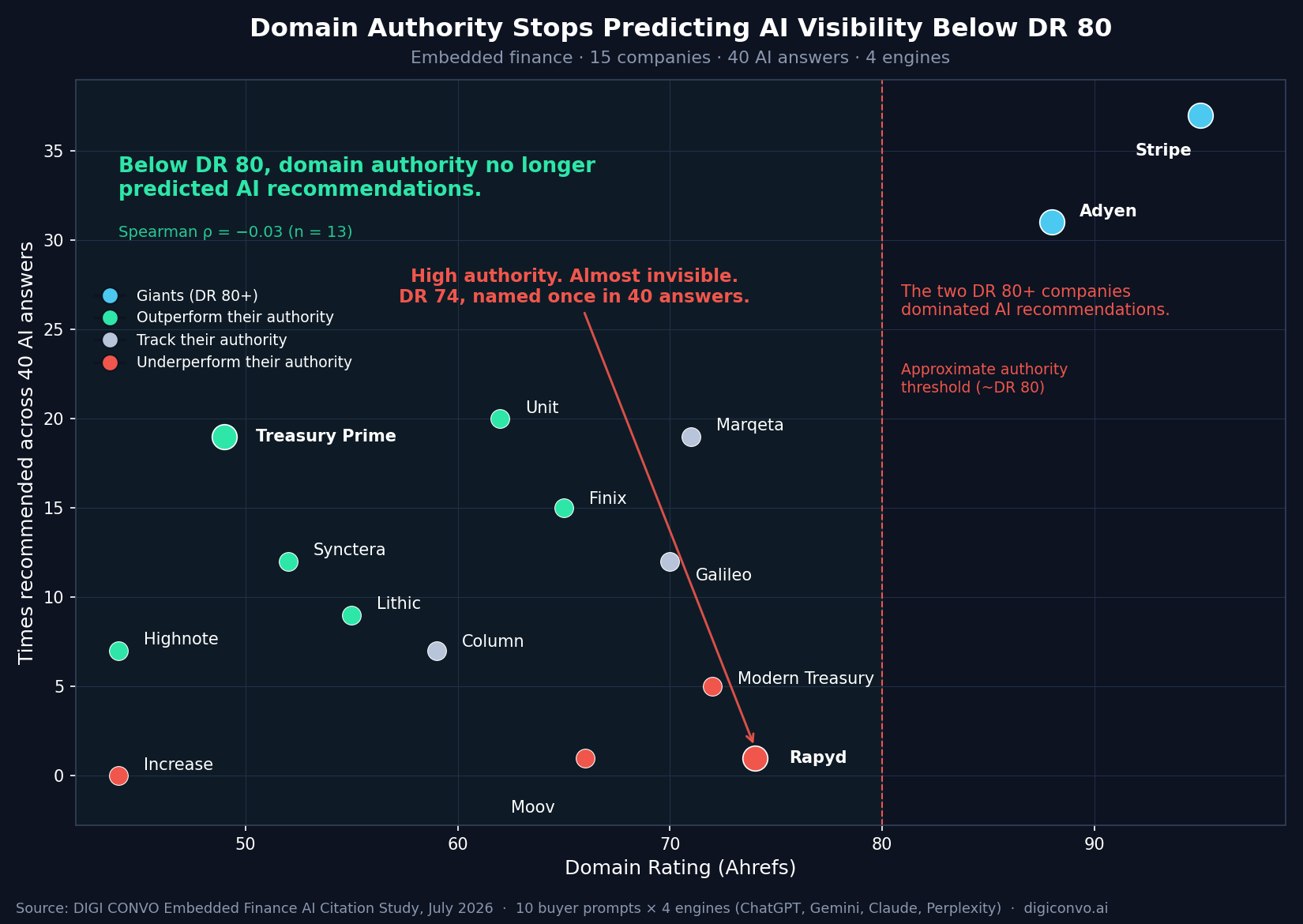
A second company, with a domain rating above 70, was being consistently outflanked in AI-generated answers by smaller players with half its DR score.
A third was sitting at position 3 for a high-value term, but a Google AI Overview answered that query above the fold and absorbed the clicks before users reached the organic results. Expected traffic at that position: 400–600 visits per month. Actual traffic: 277.
Pattern 2: Traffic Was Hiding a Strategic Weakness
Several companies had traffic charts that looked healthy. The problems were underneath.
One embedded finance company was pulling the majority of its visits from a single generic keyword that didn't describe its core product. The traffic was real. The buyers weren't. When AI tools answered queries about their actual use case, this company didn't appear because the generic content driving their rankings had no topical alignment with what they actually sell.
Another company's top-performing page was driving thousands of monthly visits from consumers, not the compliance and fraud teams they sell to. A third saw traffic triple over 12 months, but the queries driving that growth weren't from their ICP.
More visibility for the wrong queries isn't a win. It's noise with a cost, and it creates a false sense of confidence that masks a real pipeline problem.
Pattern 3: AI Visibility Was Shifting, and Nobody Was Watching It
This was the most counterintuitive finding in the entire audit set.
One infrastructure company in the payments space lost more than half its tracked keyword positions over a 90-day window. Every traditional metric pointed down. Their team was in triage mode. But their AI citations were actually increasing during the same period. Without tracking both signals, you'd only see the bad news and completely miss the directional signal that mattered more.
The inverse is equally dangerous. Some companies had stable organic metrics while their AI citation count was dropping week over week. The gap between their Google presence and their AI presence was widening, invisible in their current reporting until we ran the audit.
The lesson isn't that one channel matters more than the other. It's that they're now independent signals that can move in different directions. Optimizing for one without measuring the other is an incomplete strategy.
Pattern 4: Structure Mattered More Than Authority
One billing platform was regularly cited by AI tools. That sounds like a win until you look at which pages were getting cited.
The citations were landing on API pricing documentation rather than on buyer-facing platform pages. Developers were finding them through AI search. Finance and operations buyers -- their actual ICP -- were not. The content that should be driving evaluation was structured for human reading, not for AI extraction.
This pattern repeated across multiple companies. Businesses with significant domain authority were losing AI visibility to competitors with smaller budgets but cleaner content architecture. The smaller competitors had built pages that directly answered buyer questions: clear problem-solution framing, specific use-case language, structured explanations that AI systems can extract and cite.
The AI systems weren't rewarding authority alone. They were rewarding clarity, the same retrieval-to-selection sequence explained in the AI Visibility Funnel.
Why AI Systems Choose Different Winners
AI search tools don't operate like traditional Google rankings. They aren't primarily evaluating backlinks, domain authority, and keyword matching. They're evaluating a different set of signals:
- Extractability: Can the system pull a clear, specific answer from this content?
- Entity clarity: Is this company or product consistently and specifically described across the web?
- Topical alignment: Does this content directly address the question being asked?
- Structured specificity: Is the information concrete and citable, or generic and vague?
- Contextual relevance: Does this content match the user's actual evaluation context?
That's why smaller competitors sometimes appeared more frequently in AI-generated answers than larger, better-funded brands. It wasn't an authority question. It was a clarity question. Companies that had built content designed to answer specific buyer questions in a structured, extractable way were winning AI citations regardless of their domain rating.
Authority gets you into the consideration set. Clarity gets you cited.
The New Search Visibility Stack
The practical implication is that fintech marketing teams need to track two sets of signals, not one.
| Traditional SEO | AI Visibility |
|---|---|
| Keyword rankings | AI citations |
| Organic traffic | Inclusion in AI-generated answers |
| Domain authority | Entity clarity and consistency |
| Backlink profile | Content extractability |
| SERP position | Presence in buyer shortlists |
Most fintech companies are optimizing aggressively for the left column. The right column is increasingly where buyer attention forms: before a website visit, before a demo request, and often before a human sales interaction.
The opportunity is measurable in practice: the PayQuicker case study documents how a focused visibility program increased AI-referred traffic alongside organic growth.
The companies that understand both columns and can close the gap between them have a real advantage in categories where AI tools are already shaping which vendors get evaluated.
What This Means for Fintech Marketing Teams
The buyers conducting research through Perplexity or AI Overviews are often further along in their decision process than the buyer who scrolls page one of Google. They're looking for specific answers. The companies that appear in those answers are shaping vendor shortlists before a website visit ever happens.
For most of the 30 companies I audited, the AI Search Gap was significant and invisible in their current reporting. Strong traditional metrics were masking a real problem with buyer visibility.
The question isn't whether AI search replaces Google. It's whether your company is present when buyers use AI tools to answer the questions that determine which vendors get evaluated. Most fintech teams still don't know where they stand.
Running the AI Search Gap Diagnostic
We run AI Search Gap Diagnostics for fintech and financial services companies that want a clearer picture of their full search visibility. The session covers AI answer presence across ChatGPT, Perplexity, Gemini, and Google AI Overviews, mapped against your current keyword footprint, with a prioritized view of where the gap is costing you buyer attention.
See the DiagnosticFrequently Asked Questions
Why are fintech companies losing buyer visibility despite strong SEO rankings?
Fintech companies are losing buyer visibility because AI tools now shape vendor shortlists before buyers click Google results. Strong rankings and domain authority do not guarantee inclusion in ChatGPT, Gemini, or AI Overviews. Marketing teams should measure AI citations for buyer-intent searches, not just keyword positions.
How do fintech marketing teams improve AI search visibility?
Fintech marketing teams improve AI search visibility by publishing content built for buyer evaluation, not just traffic generation. AI systems favor pages with clear use cases, comparison language, compliance context, and structured answers. Teams should prioritize ICP-focused queries that influence demos, pipeline, and vendor selection.
What happens if our fintech brand is missing from AI-generated answers?
Missing from AI-generated answers means buyers may never evaluate your company during vendor research. Competitors with weaker SEO can still dominate AI visibility if their content is clearer and easier to extract. Revenue teams should audit AI visibility quarterly to identify gaps affecting pipeline growth and buyer discovery.
What is the AI Search Gap?
The AI Search Gap is the difference between a company's Google search presence and its visibility in AI-generated answers from tools like ChatGPT, Perplexity, Gemini, and Google AI Overviews. A wide AI Search Gap means buyers researching vendors through AI tools may never encounter your company, even if you rank well on Google.
What signals do AI search tools use to select which companies to cite?
AI search tools prioritize content extractability, entity clarity, topical alignment with the buyer's question, structured specificity, and contextual relevance. Unlike traditional Google rankings, they do not primarily reward backlinks or domain authority. Companies with clear, buyer-focused content architecture consistently outperform higher-authority competitors in AI citations.