
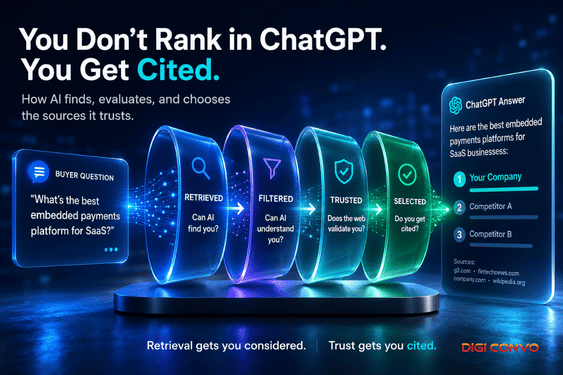
You do not rank in ChatGPT. There is no list of ten blue links to climb. ChatGPT builds each answer from sources it can retrieve and trust, so "ranking" really means becoming one of the companies it cites. For fintech, earning those citations is harder because buyers expect a higher standard of trust when evaluating financial products and services.
Ranking in ChatGPT means becoming a source ChatGPT cites when it answers a question. Unlike Google, it does not return a list of links. According to OpenAI, it generates a single synthesized answer and cites a handful of sources, so the goal is not to take a position. It is a citation.
Before you change anything, check whether you actually have the problem. Run the Five-Query Test: ask ChatGPT, Gemini, Claude, and Perplexity your five most important buyer questions. If your company rarely appears across them, you have found a visibility gap worth investigating.
This guide shows you how to earn those citations yourself. If you want the faster answer, the AI Visibility Diagnostic measures where you stand. One question drives everything that follows: if you wanted ChatGPT to consistently cite your company, what would you actually do?
"Ranking" in ChatGPT is Really Getting Cited
Google ranks pages. ChatGPT cites sources. Those are different jobs, and doing well at the first does not automatically guarantee success in the second. The pages ChatGPT cites in an answer are often not the ones at the top of Google for the same query, because retrieval and citation work differently from blue-link ranking. A company can own page one of Google and still never appear when a buyer asks ChatGPT the same question.
Broadly speaking, ChatGPT answers questions in two ways. For many prompts, it relies primarily on the knowledge built into the model. When a question benefits from current or external information, ChatGPT Search retrieves information from the web and cites relevant sources before generating a response. The two approaches work differently, but they ultimately come down to the same test: can the model find you, understand you, and trust you enough to cite you?
How ChatGPT Decides Who to Cite
Before any tactics, it helps to see the whole path an answer travels. This is the DIGI CONVO Visibility Funnel.
DIGI CONVO's Visibility Funnel: from question to citation
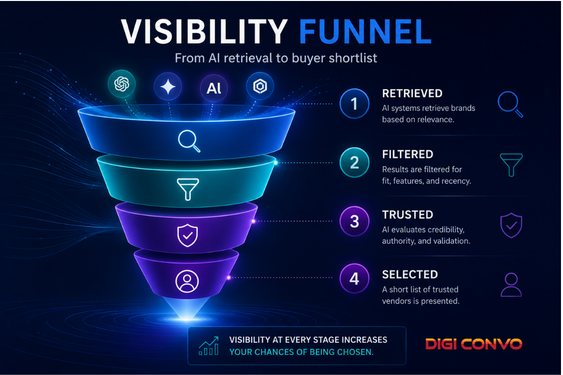
Every answer passes through those four stages.
- --Retrieved: Can the model find information about you?
- --Filtered: Can it extract a clear answer?
- --Trusted: Does independent evidence support your claims?
- --Selected: Are you one of the sources worth citing?
Most companies do not fail because ChatGPT cannot find them. They fail because ChatGPT does not see enough independent evidence to trust them. That is the stage that decides most outcomes, and it is the one companies control least directly.
According to 5W Research's 2026 citation audit, Wikipedia and Reddit alone drive more than a quarter of ChatGPT's US citations. The takeaway is not to go chase Reddit. It is that ChatGPT trusts the consensus of independent sources over what your own website says about itself. What G2, Capterra, industry press like American Banker and Finextra, and community discussions say about you in your category often carries more weight than what your homepage says about itself.
For fintech, that trust bar sits even higher, because financial answers are held to a stricter standard than most categories. The good news is that each stage is something you can improve, and that's what the rest of this guide is about.
If You Wanted ChatGPT to Consistently Cite You, Here Is What You Do
There is no trick, and no single optimization that will get you cited. Citation is the cumulative result of six things done well. The first four earn the citation, the fifth makes sure the engine can reach you at all, and the sixth tells you whether any of it is working.
Six actions to earn citations
- 1
Answer. Give each page one buyer question to answer. Not "our platform," but the exact prompt a buyer types: "best embedded payments platforms for SaaS," "Stripe Connect alternatives for marketplaces," or "which payouts provider is best for paying global contractors." One prompt, one page, one clear answer. This is page architecture, and it is where most fintech sites are thinnest.
- 2
Structure. Write the answer so a machine can extract it cleanly. Lead with the direct answer, make one claim per section, name the entities you reference, and use specific numbers instead of adjectives. A page titled "ACH versus card for recurring billing" should answer the question in its first two sentences, then support that answer.
- 3
Prove. Give the model evidence it can point to, not marketing claims it has to trust. That means original research, named authors, and real case studies with specific outcomes. It is the evidence your own site controls, and the clearest signal that you know the category. Our own Embedded Finance AI Citation Study is exactly this type of evidence: original data, named methodology, citable finding. The embedded finance platform case study shows the same principle applied to a commercial visibility program.
- 4
Reinforce. Get the rest of the web to describe you the way you describe yourself: the same one-sentence category positioning on Wikipedia, Crunchbase, G2, LinkedIn, and industry press. Where Prove is what you say about your company, Reinforce is the independent consensus that makes the model believe it. In fintech, this is the decisive part, because the trust bar is higher.
- 5
Enable. Make sure ChatGPT Search can access your content. Allow OAI-SearchBot in your
robots.txt, and check that your firewall, CDN, or bot-protection settings are not blocking it. Keep important pages publicly accessible and technically crawlable. GPTBot is separate: it controls whether content may be used for model training and is not required for inclusion in ChatGPT Search. Treat access as a gate. If OpenAI cannot crawl the page, the rest of your work may never be considered. - 6
Measure. Return to the Five-Query Test you ran at the start. Make it a monthly habit, track your Citation Rate across ChatGPT, Gemini, Claude, and Perplexity, and watch who gets named and whether the answer moves. What you cannot measure, you cannot improve.
Why Schema Won't Get You Cited
Schema is one of the most misunderstood ideas in AI visibility. It helps machines understand your company. It does not make ChatGPT cite you.
When Ahrefs tracked 1,885 pages that added schema markup, AI citations barely moved. Structured data is still worth implementing, because it makes your entity clearer and your content easier to parse, which supports the Structure and Reinforce steps above. But it is table stakes, not a lever. Adding schema to a page the web does not already trust will not get you cited.
If a guide tells you that schema is the secret to getting cited, it confuses clarity with trust. Schema helps AI understand you. Trust is what gets you cited.
How Long It Takes
No honest guide promises citations overnight. The work pays off on three different clocks. Access, the technical layer, can move in weeks: unblock the crawlers, fix rendering, get indexed and crawlable, and you become retrievable almost immediately.
Content and structure evolve over roughly one to two months as you publish pages that answer real buyer questions in an extractable format. Entity trust, the Reinforce layer, is the slow, compounding part. It develops over several months as independent sources describe you consistently, which is exactly why the goal is to be cited consistently rather than once.
The companies that start now pull ahead. Trust compounds, and so do citations.
FAQs
Does ranking on Google get me into ChatGPT?
Not automatically. Strong Google rankings help, but ChatGPT frequently cites pages that are not on Google's first page. It weighs whether it can retrieve, understand, and trust a source, so you can rank well on Google and still be absent from AI answers.
Do I need schema to get cited?
Schema is worth adding, but it will not earn citations on its own. It helps AI understand your company, which supports extractability and entity clarity. Citations come from trust built across the web, not from markup.
How is ranking in ChatGPT different for fintech?
Financial topics face a higher trust bar. Because financial answers carry greater consequences, AI engines lean more heavily on independent validation, consistent entity data, and credible third-party sources before naming a fintech company. That is why the Trusted stage decides more of the outcome.
How do I check whether ChatGPT already cites us?
Run the Five-Query Test: ask ChatGPT, Gemini, Claude, and Perplexity your five most important buyer questions and record whether your company appears. Repeat monthly to track your Citation Rate and see which competitors hold the positions you want.
See where AI already cites you, where it doesn't, and which buyer questions your competitors own instead. The AI Visibility Diagnostic maps your Citation Rate and the gaps across ChatGPT, Gemini, Claude, and Perplexity, using the fintech queries your buyers actually type.
Keep reading: "How Fintech Buyers Use ChatGPT to Evaluate Vendors" explains why more buyers now begin vendor research with AI.