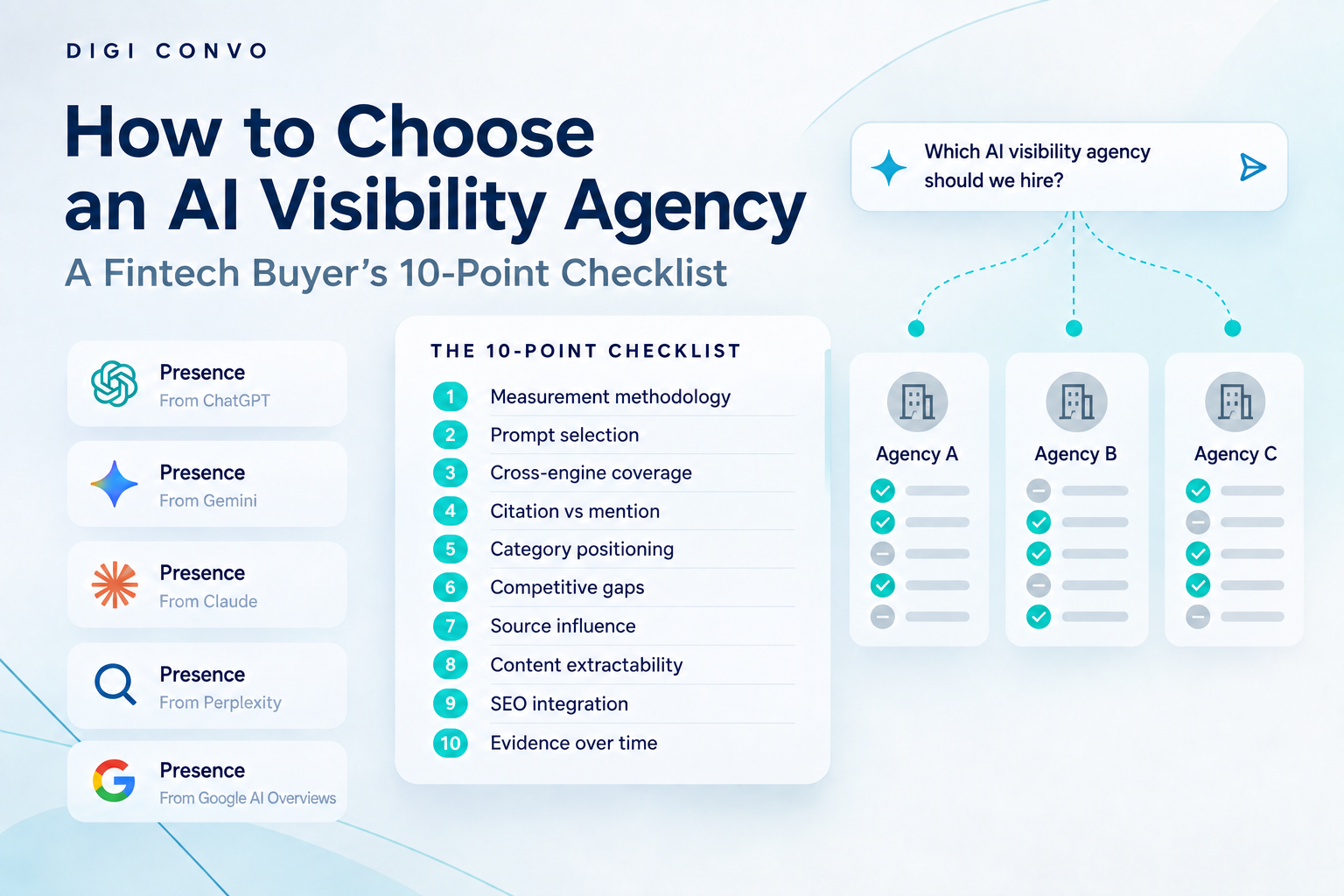
Choosing an AI visibility agency comes down to one question the sales pitch will not answer: can they actually measure whether your fintech appears in AI answers, or are they repackaging traditional SEO reporting?
This is the checklist I use to tell a mature practice from a basic one, and it is built to be run on anyone, including us. AI visibility is a measurable discipline, and the ten questions below are how you hold an agency to that standard.
What an AI Visibility Agency Actually Does
When a buyer asks ChatGPT, Gemini, Claude, or Perplexity to recommend vendors in your category, your company is either named in the answer or it is not. An AI visibility agency works to get you found, cited, and selected in those answers.
In practice, answer engine optimization (AEO) often refers to making content easy for answer systems to interpret and extract. In contrast, generative engine optimization (GEO) usually refers more broadly to improving how a brand appears in generative answers and recommendations. These are the same category questions where buyers weigh Stripe, Adyen, and Plaid against smaller challengers.
You will see this sold under several labels: AI visibility agency, AI SEO agency, GEO agency, answer engine optimization agency. The differences are emphasis, not discipline. What separates a good one from a weak one is not the name on the door. It is whether a real measurement system backs it up. For the underlying framework, see our explainer on how AEO and GEO differ.
Why the Category Is Hard to Evaluate
The category is new enough that there is no broadly accepted industry standard yet. Many firms now use AI SEO, GEO, or AEO language, but the label alone tells you very little about how the work is actually measured. From the outside, a serious practice and a repackaged SEO shop can look identical, until you ask the right questions.
Buyers searching for the best AI SEO agency are usually asking the wrong first question. The better one is whether the agency can prove what it measures. That is the entire purpose of what follows: the ten questions below are designed to surface, in one conversation, whether an agency has a measurement system or just a vocabulary.
Do This 10-Minute Test First
Before you take a single sales call, run your own quick baseline. Take five to ten unbranded category questions your buyers would actually ask, the kind that never include your brand name, and run each one across ChatGPT, Gemini, Perplexity, and Google's AI Overviews. Record four things:
- whether your company appears at all
- which competitors appear instead
- which sources get cited in the answer
- whether the answer changes from one engine to the next
Treat this as a directional spot check, not a measurement. A single pass is noisy, and answers can shift from one run to the next on the same engine, so what you are looking for is the pattern rather than any one result: are you consistently absent while the same competitors are consistently named?
That gives you a small but real read to bring into the agency conversation, and it makes every question below concrete instead of abstract. If you would rather not run it by hand, that is essentially where our AI Visibility Diagnostic starts.
The 10-Point Checklist
| # | What to Evaluate | The Question to Ask |
|---|---|---|
| 1 | Measurement methodology | How do you measure whether we appear in AI answers? |
| 2 | Prompt selection | How do you decide which questions are worth tracking? |
| 3 | Cross-engine coverage | Which engines do you measure? |
| 4 | Citation vs mention | What is the difference between being mentioned and being cited? |
| 5 | Category positioning | Which entities and topics do we need to be associated with? |
| 6 | Competitive gaps | Can you show where competitors appear and we do not? |
| 7 | Source influence | Which third-party sources are shaping answers in our category? |
| 8 | Content extractability | How do you make our content something AI will quote? |
| 9 | SEO integration | How do GEO and SEO fit together in your approach? |
| 10 | Evidence over time | Can you show visibility changing month over month? |
1. Measurement methodology. Ask how they measure whether you appear in AI answers. A lot of AI SEO reporting is repackaged organic traffic and AI Overview impressions. An AI Overview impression is a real signal that one of your pages surfaced near an AI answer, but it does not tell you whether an engine actually named your company or cited your page as a source, which is the thing you are buying.
A strong answer describes prompt-level presence measured directly inside ChatGPT, Gemini, Claude, and Perplexity. The red flag is a dashboard of GA4 sessions relabeled as AI visibility.
2. Prompt selection. Ask how they decide which questions to track. The wrong query set makes every number meaningless.
A strong answer starts from real buyer-intent category questions, unbranded, mapped to your verticals, the questions a prospect types before they know your name. The red flag is a generic keyword list, or tracking prompts that include your brand, which bias the test toward known-entity retrieval and never measure whether you are discoverable in the category before a buyer knows your name.
3. Cross-engine coverage. Ask which engines they measure. The same fintech can dominate in one engine and be absent in another. In our own 51-company benchmark, no company reached the top tier of visibility without appearing across at least three of four engines.
A strong answer covers ChatGPT, Gemini, Claude, Perplexity, and Google AI Overviews. The red flag is "we track ChatGPT," full stop. The evidence for this is in our 2026 Fintech AI Visibility Benchmark.
4. Citation vs. mention. Ask them to define the difference between being mentioned and being cited. A strong measurement system distinguishes at least three things: whether your brand was mentioned, whether it was actually included as a recommendation, and whether one of your pages was cited as a source.
Those are different events, and an agency that can tell you which one you are winning is measuring something real. The red flag is using the terms interchangeably, because it usually means they measure none of them precisely.
5. Category positioning. Ask which entities and topics you need to be associated with. AI visibility depends heavily on whether systems understand what your company is, what category it belongs in, and which topics it should be linked to. Traditional link authority alone does not guarantee inclusion.
A strong answer is a specific map of the concepts and category language you need to own. The red flag is a vague promise to build authority.
6. Competitive gaps. Ask them to show where competitors appear, and you don't. One of the clearest ways to make AI visibility actionable is to see exactly where a competitor is cited for a category query, and you are absent.
A good agency can produce that gap on your real data and turn it into a prioritized plan. The red flag is an agency that can only discuss the idea in the abstract, never on your actual queries. Some of this gap analysis can be done with software alone, while other parts require interpretation and strategy, a distinction we break down in AI Visibility Tools vs Agency Services.
7. Source influence. Ask which third-party sources appear in the answers in your category. Much of AI visibility comes from sources outside your domain, including comparison pages, reviews, and trade publications. You can observe which of these show up as citations; whether they actually shaped the answer is an inference, and a good practice is to be honest about that line.
A strong practice is to name the sources that recur in your category's answers and have a plan to earn placement in them. The red flag is on-page-only thinking that stops at your own website.
8. Content extractability. Ask how they make your content something AI will quote. AI systems are more likely to use content they can interpret, extract, and support confidently. A strong article that buries its answer can be less useful to an answer engine than a plainly structured source.
A good answer covers direct-answer formatting, comparison structure, entity clarity, and structured markup where it helps interpretation. The red flag is "we will publish more blog posts."
9. SEO integration. Ask how generative engine optimization and traditional SEO fit together in their approach. The two are connected systems, not rivals, and an agency that treats one as dead or ignores it entirely leaves visibility on the table.
A strong answer explains how ranking work and AI citation work share foundations and where they diverge, rather than assuming one automatically delivers the other. The red flag is "SEO is dead" energy, or no coherent view of the relationship at all.
10. Evidence over time. Ask them to show visibility changing month over month for a real account. Anyone can produce a single flattering snapshot.
A practice with a real measurement system should show a longitudinal record: where an account started, what changed, and what work corresponded with that movement. The red flag is one dated screenshot and a promise about what comes next.
What the Ten Questions Reveal
Taken together, the ten questions reveal whether an agency has a real measurement system behind the terminology, or a vocabulary in front of a traditional SEO retainer. The pattern to watch is consistency: rigorous measurement, cross-engine coverage, a clear line between mention and citation, and evidence that visibility actually moved.
Some agencies sound strong on the first few questions and get much vaguer as you move into cross-engine measurement, citation analysis, source influence, and evidence over time. Those later questions decide whether the work is real.
The deeper point is worth holding onto as a buyer. AI visibility is not a vague marketing promise. It is a measurable discipline, and any agency worth hiring should be able to prove it on your data before you spend anything.
Use the Checklist on Us
If you are evaluating DIGI CONVO, bring these ten questions to the call. I will show you exactly how we handle each one, including the parts where our approach may not be the right fit for you.
Run an AI Visibility DiagnosticFAQs
How Many Prompts Should an AI Visibility Agency Track?
There is no universal number, but the prompt set should be large enough to cover the buyer questions that matter across your priority categories. More important than volume is whether the prompts are unbranded, relevant, repeatable, and tied to real buying intent.
How Often Should AI Visibility Be Measured?
Measure AI visibility on a consistent schedule using the same prompt set and the same engines. Regular measurement matters because results can change over time and vary from one run to another.
Can AI Visibility Be Tied to Revenue or Pipeline?
Not cleanly in every case. AI visibility can show whether your brand is appearing in the answers buyers see, but connecting that exposure to revenue usually requires additional attribution data such as referral traffic, assisted conversions, or sales-source tracking.
Can Software Replace an AI Visibility Agency?
Software can handle much of the monitoring, prompt tracking, and competitive reporting. An agency becomes more useful when the work also requires interpreting the data, prioritizing opportunities, changing content and positioning, and coordinating off-site visibility.
How Long Does It Take to Improve AI Visibility?
No reliable universal timeline exists because results depend on your starting visibility, category, competitors, content, and the sources AI systems rely on. A credible agency should set expectations around measurable movement over time rather than promise a fixed number of days.